
Leh to Pangong Lake Taxi
Book a Leh to Pangong Lake taxi with local Ladakhi drivers. Real Chang La route details, fares, permits & tips from a Ladakh travel expert.
Leh to Pangong Lake Taxi: Complete Route, Fare & Booking
Most guides only show the postcard version. In reality, road conditions, altitude, permits and taxi union rules directly affect your cost, travel time and overall experience.
In this guide, you will find the exact route, updated taxi fares, travel duration, permit requirements and practical booking advice based on how trips actually operate on the ground.Leh to Pangong Route Overview
- Distance (Leh to Spangmik/Pangong): 150–160 km
- Travel time (one-way): 5–7 hours
- Route: Leh → Shey → Karu → Sakti → Chang La → Durbuk → Tangtse → Lukung →Spangmik
- Highest point: Chang La, 17,688 ft (5,390 m)
- Lake altitude : 14,270 ft (4,350 m)
- Permit required: Inner Line Permit (ILP) — for both Indian and foreign nationals
- Best months: Late May to late September
- Recommended vehicle: SUV (Innova, Xylo, Scorpio) or Tempo Traveller for groups
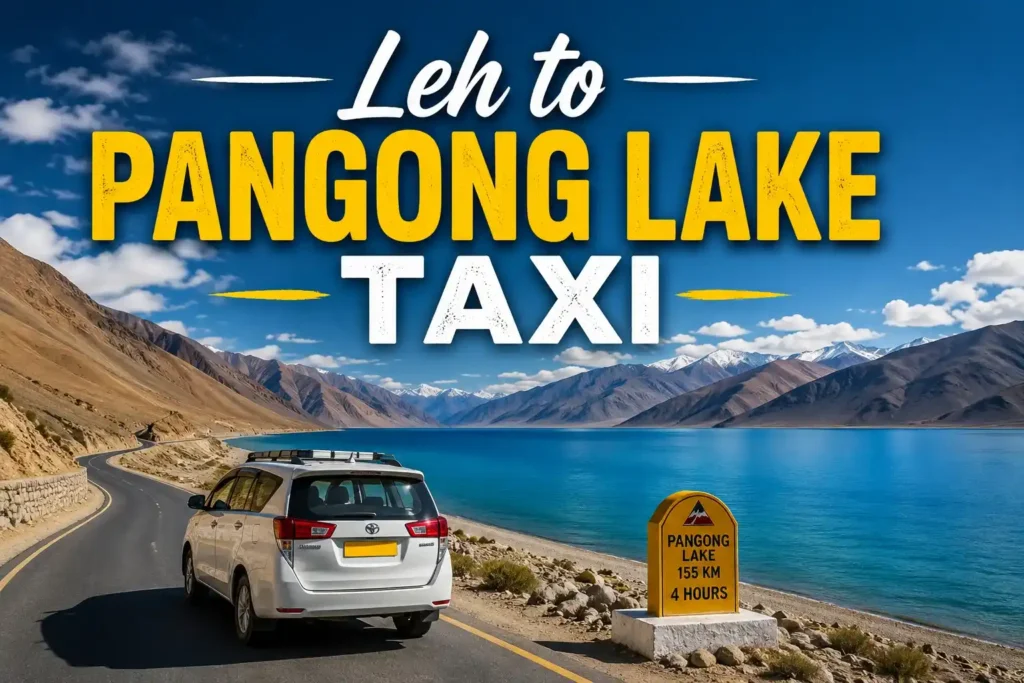
Official 2026 Leh to Pangong Taxi Union Pricing & Fleet Choices
Fares here are set by the local taxi union and reasonably consistent, with variation based on whether you are doing a rushed one day trip or the more comfortable overnight version. The pricing below matches the Official 2026 Union Tariff for standard point-to-point circuits using clean, high-clearance commercial fleets.
| Circuit / Route Details | Taxi rates |
|---|---|
| Leh to Pangong Lake (1-Day Round Trip) | ₹18,000- ₹24,000 |
| Leh – Pangong – Leh (2 Days / 1 Night Stay) | ₹20,000- ₹26,000 |
| Leh – Pangong (via Merak & Chushul) – Leh (2 Days) | ₹22,000-₹28,000 |
| Leh – Nubra – Pangong via Shyok – Leh (3 Days) | ₹26,000-₹36,000 |
| Leh – Nubra – Pangong- Tsomoriri lake (4 Days) | ₹37,000-₹50,000 |
| Leh – Nubra – Pangong-Hanle- Tsomoriri lake (5 Days Grand Circuit) | ₹37,000-₹50,000 |
These are private hire rates and generally include the driver’s food and stay, they typically exclude your own accommodation at Spangmik, meals and the Inner Line Permit fee. Expect prices toward the higher end of these ranges in July-August and note that a same-day one-day trip, while cheaper, means roughly 10-12 hours on the road for perhaps two hours actually at the lake most experienced travelers regret not staying the night.
Note: The above rates are indicative and may vary. Please confirm the final fare before booking by calling or WhatsApping us anytime, 24×7.
Choosing Your Taxi: Vehicle Types and Pricing
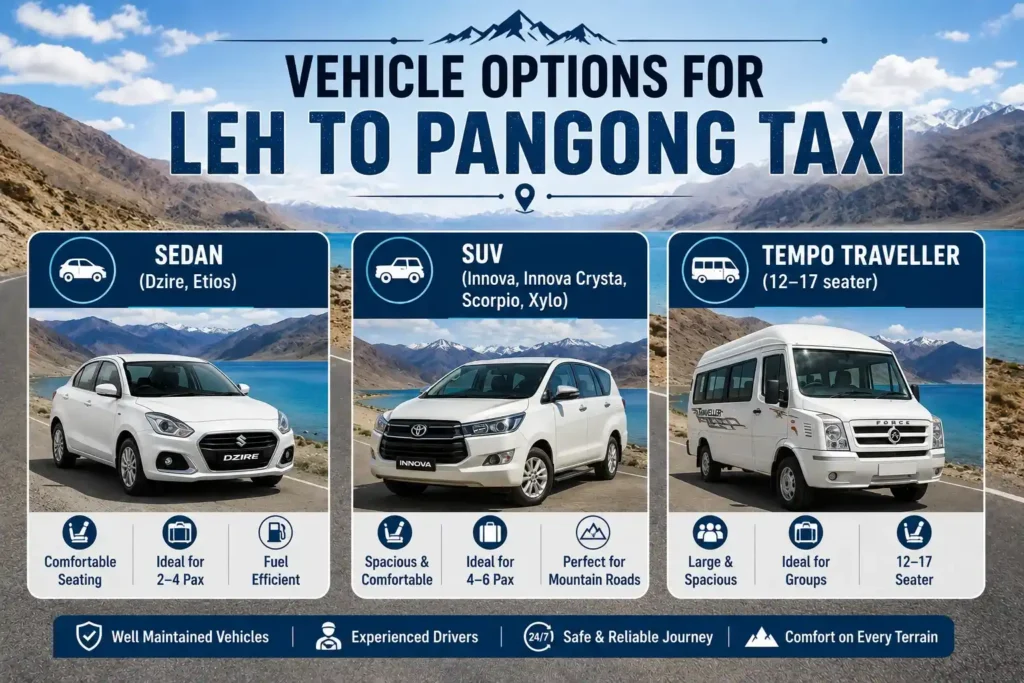
Vehicle Options for Leh to Pangong Taxi
- Sedan (Dzire, Etios): Some operators list these, but they are not the practical choice, the shoreline road and the pass itself are better suited to higher ground clearance.
- SUV (Innova, Innova Crysta, Scorpio, Xylo): The standard for this route and what most Ladakh taxi unions default to for Pangong bookings.
- Tempo Traveller (12–17 seater): A solid option for groups, since the road width allows it for nearly the entire route.
The Complete Route: Leh to Pangong Lake via Chang La
The high-altitude drive from Leh to Pangong Tso takes you out of the Indus Valley and straight up into the heart of the rugged Changthang plateau.
[Leh Town] ➔ (35 km) ➔ [Karu Junction] ➔ (40 km) ➔ [Chang La Pass] ➔ (35 km) ➔ [Tangtse Village] ➔ (40 km) ➔ [Lukung / Spangmik]
Distance, Travel Time and Road Conditions
The drive from Leh to Pangong Lake covers roughly 150-160 km and takes 5 to 7 hours one way longer than the distance suggests, because a third of it is spent climbing and descending Chang La and the final stretch along the lake’s edge is a slow, winding single lane road that doesn’t allow for much speed regardless of how good the surface is.
Road conditions through the season:
- June to mid-September: The most reliable window. The road is BRO-maintained and generally in decent shape, though the final approach into Spangmik along the lake can still be rough gravel in patches.
- Late May and late September: Chang La can still have icy patches early in the morning and temperatures at the lake drop sharply after sunset. Doable, but start early and dress for genuine cold, not just “cool mountain weather.”
- Winter (October through April): Chang La becomes difficult to impossible depending on snowfall and the lake itself freezes over. Tourist taxi traffic on this route effectively stops for the season.
- Wind factor: Unlike the Khardung La route, the Pangong road runs along an open valley for a long stretch near Durbuk and Tangtse, where crosswinds can be strong enough that drivers slow down noticeably not dangerous, but worth knowing if you are prone to motion sickness on a swaying vehicle.
Key Stops and Checkpoints En Route
- Shey: Just outside Leh, home to Shey Palace and a large Buddha statue, a common quick stop if you are starting early and want a five-minute photo break before the long climb begins.
- Karu: A small junction town where the road to Pangong splits from the road heading toward Tso Moriri via Chumathang. This is also roughly where drivers top up fuel, since options thin out after this point.
- Sakti (Shakti): The last proper village before the climb to Chang La starts in earnest.
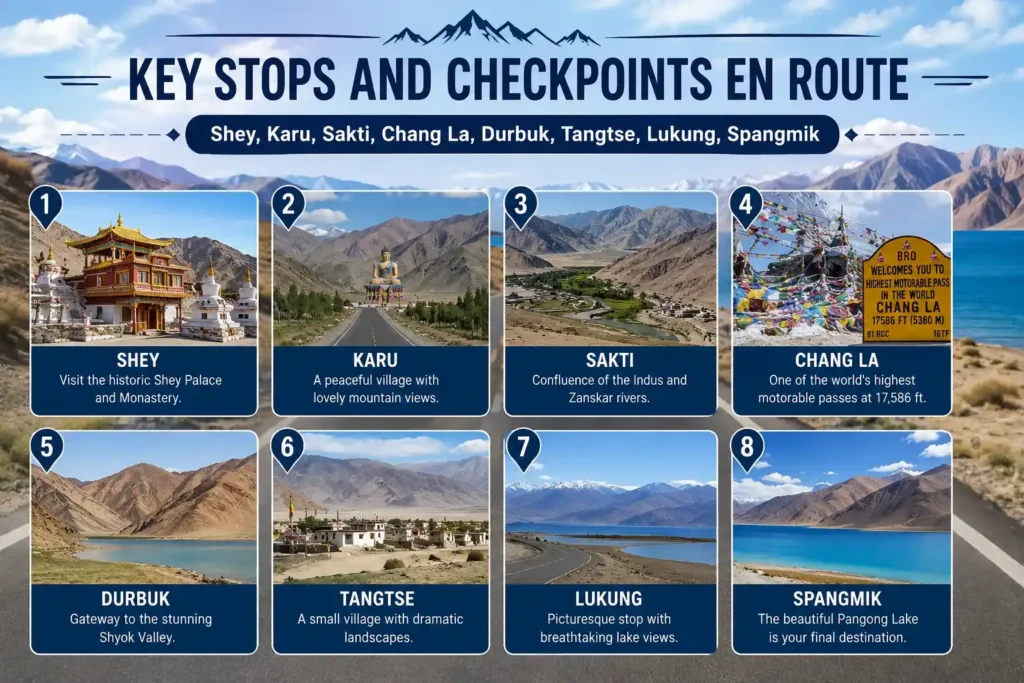
- Chang La: The summit and the second highest pass most Ladakh circuits cross (after Khardung La on the Nubra side). There’s a small army run tea stall here, prayer flags, and a signboard but this pass gets noticeably colder and windier than Khardung La, so most drivers keep the stop brief.
- Durbuk: The checkpoint village where your Inner Line Permit is typically verified on the way to Pangong. Keep a couple of photocopies on hand.
- Tangtse: A small administrative town with basic facilities the last place with reliable fuel and food options before the lake itself.
Lukung: The point where the road meets the lake’s edge for the first time. Some itineraries stop here briefly before continuing to Spangmik. - Spangmik: The main village where most taxi trips base you for the night, this is the stretch made famous by films and is where the majority of camps and guesthouses are concentrated.
Scenic Viewpoints and Photography Spots
- Chang La summit — the classic high-pass shot, though the light here tends to be flatter than at Khardung La due to the terrain late morning generally works better than midday.
- The descent into Durbuk valley — a wide, open stretch where the road drops from bare high altitude terrain into a broader valley with a river running through it a strong contrast shot if you are documenting the full journey.
- First lake view near Lukung — this is genuinely the moment most people describe as the trip’s payoff. The lake’s color shifts through blues and greens depending on the light and this first vantage point captures the full width of the water better than most spots further along.
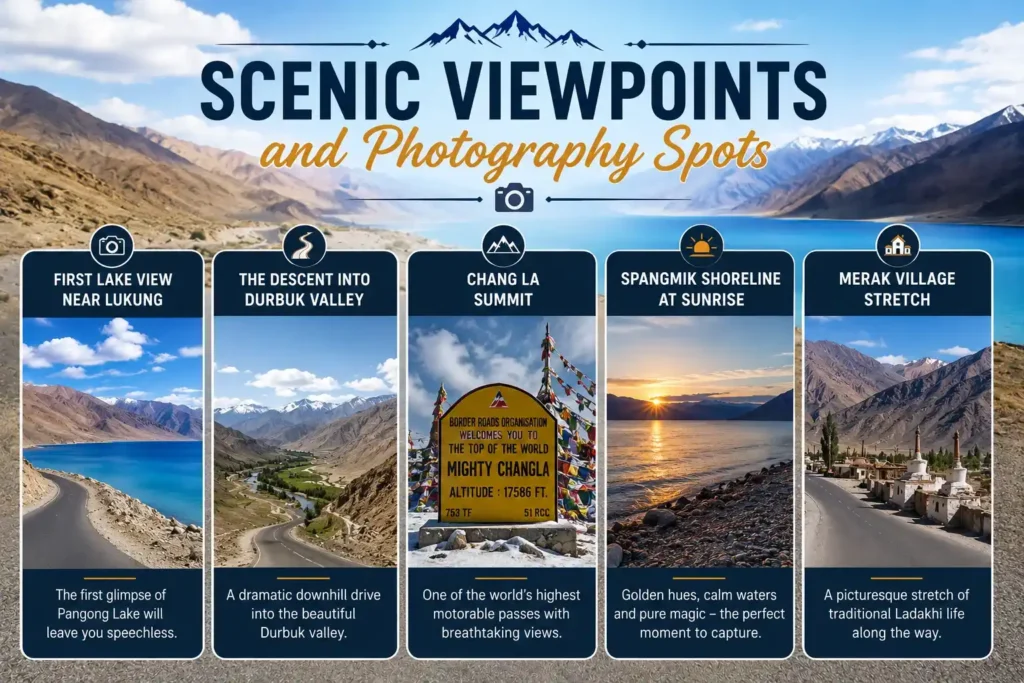
- Spangmik shoreline at sunrise — the color change on the water in the first hour after sunrise is dramatic and is why most serious photographers choose to overnight here rather than do a rushed same day trip.
- Merak village stretch (if your itinerary extends beyond Spangmik) a quieter, less photographed section of shoreline with fewer tourists in frame.
Permits, Altitude and Practical Travel Tips
Permits: An Inner Line Permit is mandatory for every traveler heading to Pangong Lake, Indian or foreign. It’s arranged online through the Ladakh administration’s portal or through your taxi operator, usually processed within a day. Carry printed copies checkpoint connectivity at Durbuk isn’t always dependable enough to pull up a digital version on demand.
Altitude: This is the detail most trip planning guides underplay. Pangong Lake sits higher than Leh itself and you are crossing Chang La, a pass nearly as high as Khardung La to get there. Spending at least a day acclimatizing in Leh before this trip isn’t optional advice, it’s the difference between enjoying the lake and spending your evening at camp with a pounding headache. Nights at Spangmik get cold even in peak summer; altitude and temperature drop together after dark.
Best time to travel: Late May through late September is the realistic window. July and August are peak season with the most stable roads but also the most crowded lakeside camps and the busiest queue at Chang La. Late May and September offer a quieter lake and comparably good weather, with a slightly higher chance of a cold morning at the pass.
Vehicle type: Same logic as the Nubra route, an SUV (Innova, Xylo, Scorpio) is the practical standard. The final stretch along the lake’s shoreline has rough, semi graded sections where a low clearance sedan will struggle and feel uncomfortable even where it technically fits. For groups, a Tempo Traveller works well since the roads here, unlike some other Ladakh routes, are wide enough for larger vehicles for most of the way.
Combining Leh to Pangong Lake With Nubra Valley?
Some travelers connect Pangong directly to a Nubra Valley trip via the Wari La route, avoiding a return to Leh in between. This adds meaningful driving time and a second high pass in a single itinerary, so it’s worth planning deliberately rather than adding on impulse. If you are building a multi day circuit covering both destinations with or without Turtuk or Tso Moriri see our Ladakh circuit tour packages for combined itinerary pricing.
How to Book Leh to Pangong Taxi
Call or WhatsApp us with:
• Travel date
• Pickup location (hotel/airport)
• Number of passengers
• One-way or round trip
We will check availability, share the exact Leh to Pangong Lake taxi fare and confirm your booking instantly.
Advance booking is strongly recommended during peak season (May to September) due to limited vehicle availability.
Call Now: +91-9796466052
Email: infotravelmykashmir@gmail.com
WhatsApp: +91-9796466052
Book Your Leh to Pangong Lake cab
Book a Leh to Pangong Lake taxi with transparent pricing for sedans, SUVs and Tempo Travellers. Driven by experienced local drivers, our cabs are ideal for high altitude routes via Chang La, ensuring a safe and reliable journey with 24/7 booking support.
Frequently Asked Questions
Q: Is a one day trip to Pangong Lake from Leh worth it or should I stay overnight?
A: A same day trip is possible but means roughly 10-12 hours of driving for a few hours at the lake. Most travelers who have done both say the overnight version is worth the extra cost, you get sunrise or sunset light on the water, which is when the color change everyone photographs actually happens and you are not rushing the return drive over Chang La in fading light.
Q: How cold does it get at Pangong Lake at night, even in summer?
A: Nights at Spangmik regularly drop close to freezing even in July and August, since the lake sits above 14,000 ft. Pack proper thermal layers regardless of how warm Leh feels during the day camps and guesthouses here have basic heating at best.
Q: Can I visit Pangong Lake and Nubra Valley in the same trip without returning to Leh in between?
A: Yes, via the Wari La route connecting Nubra and Pangong directly, though this adds significant driving time and crosses an additional high pass. Most standard itineraries still route back through Leh between the two, which is more common and generally more comfortable unless you are specifically after the direct connection route.
Q: Do I need a different Inner Line Permit for Pangong Lake than for Nubra Valley?
A: The ILP process is similar for both, but they are typically applied for as separate permits or as part of a combined application depending on your full itinerary. If you are visiting both, mention this to your operator upfront so both permits are arranged together rather than sequentially.
Q: Is Pangong Lake actually as blue as it looks in photos or is that edited
A: The color is real, though it shifts significantly through the day often deep blue at midday, greener in early morning and late afternoon light. Photos taken during peak sun tend to look the most saturated, which is part of why the lake photographs so consistently well regardless of who’s taking the picture.
Q: Which pass is tougher Chang La on the way to Pangong or Khardung La on the way to Nubra?
A: Both sit close in elevation, but Chang La tends to feel colder and windier due to its exposure, while Khardung La sees heavier tourist traffic and longer queues at the summit in peak season. Neither is technically difficult for an experienced local driver the main variable is how your body handles the sudden altitude gain either way.
Q: Are there fuel stations near Pangong Lake or should I plan ahead?
A: No fuel stations operate near the lake itself Tangtse is the last reliable fuel stop before Pangong. Local taxis account for this in their route planning, but if you are self driving, top up in Leh or Karu and don’t rely on finding fuel closer to the lake.
Q: Can we stay in tents right along the edge of Pangong Lake?
A: No. To protect the fragile local ecosystem, the National Green Tribunal and local authorities have banned all commercial camps and permanent structures within 500 meters of the waterline. Accommodations are located further back in the villages of Spangmik, Man and Merak, offering safe, eco-friendly homestays and fixed wooden cottages.
Q: Which vehicle type is best for the drive from Leh to Pangong Lake?
A: You should only use high ground clearance vehicles for this route. For small groups or families of up to 4 passengers, a Toyota Innova, Mahindra Scorpio or Tata Hexa offers the perfect combination of suspension and power. For larger groups of 6 to 12 travelers, a modified Force Tempo Traveller is the reliable choice. Low-slung hatchbacks and sedans are highly discouraged due to the rough terrain around Chang La.
Q: Is the road through Chang La open during the winter months?
A: The Border Roads Organisation keeps the pass clear for military convoys throughout the year. However, unexpected heavy winter snowfalls, ice sheets or seasonal avalanches between November and April can temporarily close the pass for a few days. The most reliable window for holiday travel is from mid-May to late October.
Related Reading
- Srinagar to Leh Taxi Booking — planning the full road trip into Ladakh
- Leh to Nubra Valley Taxi — for combining Pangong with a Nubra Valley trip
- 7 Top Tips to Hire a Taxi from Srinagar to Leh — practical advice for the approach journey
- Innova Cab Service in Kashmir — the recommended vehicle class for high-altitude routes
- Tempo Traveller Options in Kashmir — for larger family or group bookings
- Taxi Rates in Kashmir — for comparing fares across regions
Popular Kashmir Taxi Routes
- Srinagar to Pahalgam Taxi
- Srinagar to Leh Taxi
- Srinagar to Gulmarg Taxi
- Amarnath Yatra Taxi
- Srinagar to Sonmarg Taxi
- Srinagar to Yusmarg Taxi
- Srinagar to Doodhpathri Taxi
- Srinagar to Gurez Taxi
- Srinagar to Sinthan Top Taxi
- Srinagar to Bangus valley Taxi
- Srinagar to Keran Taxi
- Srinagar to Leh Tempo Traveller